



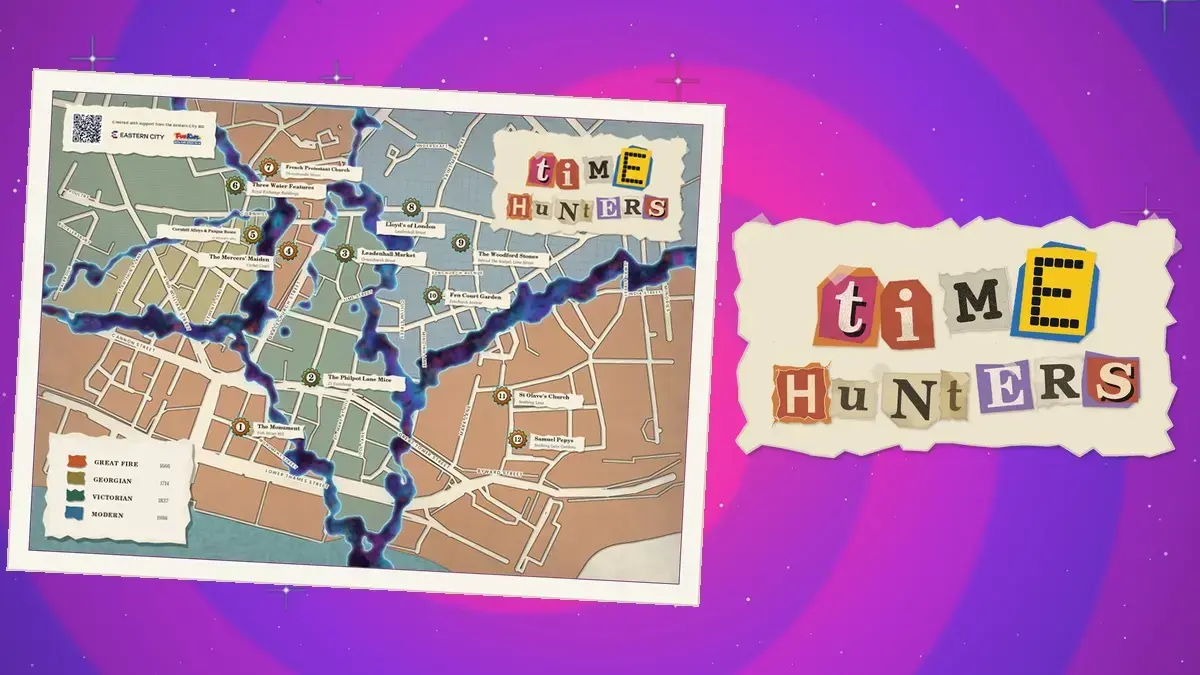
Check out the other Time Hunter trails
Oh, pleased to see you! Come in, come in! My name is Professor Horatio Pendulum. Keeper of the Timeaporium Clock Shop – repairer of ancient timepieces, collector of impossible objects… and, regrettably, the person responsible for what may soon become the greatest disaster in London history. There’s no easy way to put this. I may have accidentally caused a rift in space time!
You see, hidden beneath the Timeaporium, I’ve built a machine known as the Chronosphere – a magnificent invention designed to peer safely into history itself. But I overloaded it and it’s created some time fragments across London. History is leaking. Past and present are becoming tangled together like knotted clock springs. Objects, people and places from different centuries have scattered themselves across the city.
I need some help to restore everything to its rightful place in time. Can you help and become a Time Hunter? You just need to follow some riddles found by the Chronosphere to track down time fragments that have been thrown into famous landmarks, ancient ruins, forgotten corners and curious monuments, to put things right.
A Monument to a Garden is a free, self-guided Time Hunters walk that begins at the Monument, built to remember the Great Fire of London, and winds through hidden alleys, markets and courtyards of the eastern City of London before finishing on Seething Lane Garden, where someone dug a hole to hid his chees from the Great Fire!!
Twelve stops, a fold-up treasure map, a pocketful of riddles and missions — and around 400 years of history to hunt down along the way.
How the hunt works
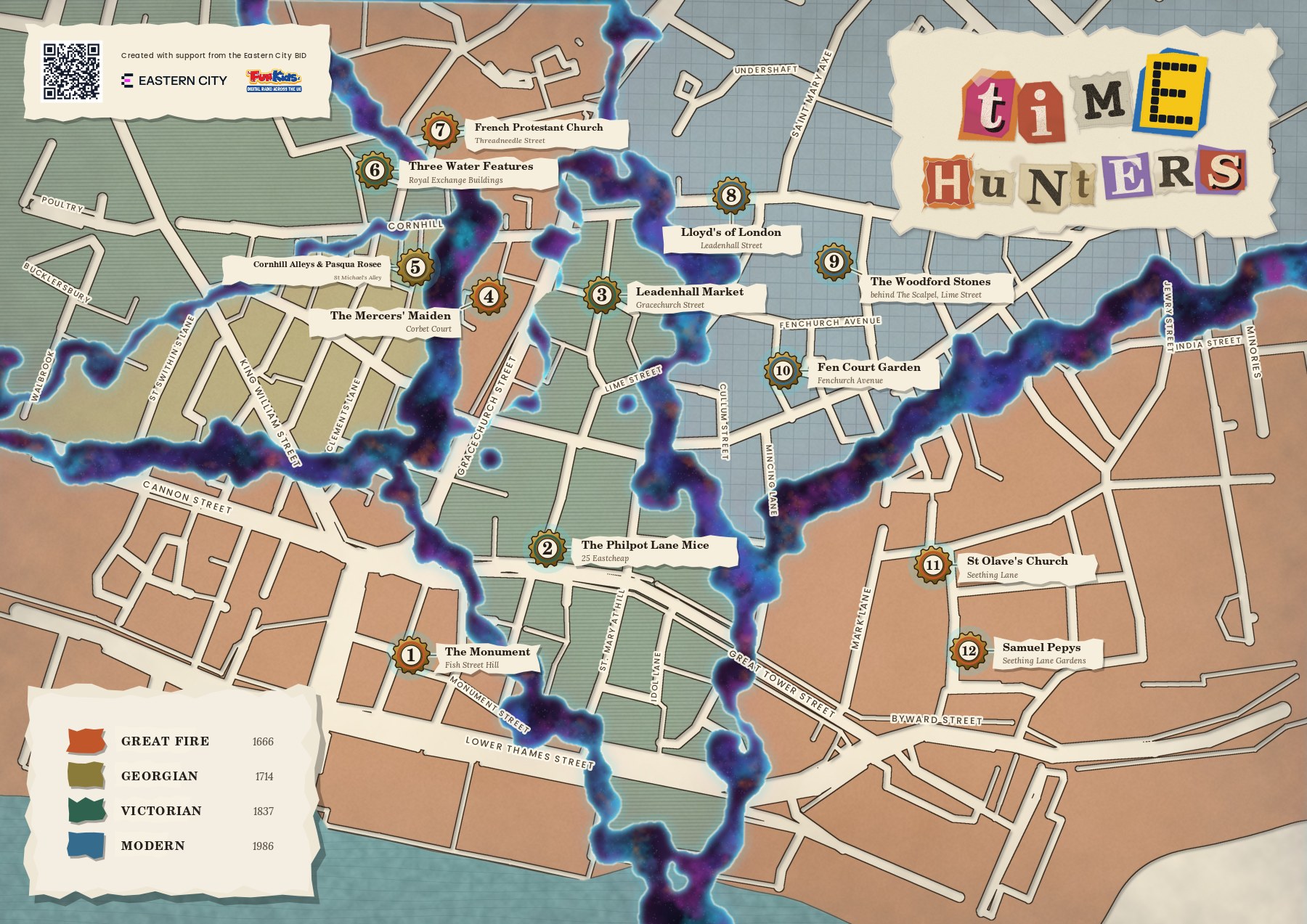
Print the map. Each trail is a single sheet of A3 that folds down to pocket size — a fractured map of the City on one side, and an activity handbook on the other with a card for every stop.
Listen to the podcast. Every stop has a riddle, read aloud in the Time Hunters podcast, that points you to the next place on the trail.
Hunt down all 12 stops. There is no route drawn on the map — on purpose. The best ways through the City go down tiny alleys and courtyards, and we didn’t want to give them away. Follow the numbers and explore.
Solve the missions. Each stop sets a mission — a plaque to find, a carving to count, a detail to spot. Grown-ups get a printable answer key to check them.
The map is torn into coloured shards, one for each era: Roman, Medieval, Tudor, Great Fire, Georgian, Victorian and Modern. Cross from one colour to another and you’ve time-travelled.
The 12 stops on the Trail
From Monument to Seething Lane. Allow about 2–2½ hours with the podcast and the puzzles.
1. The Monument
Fish Street Hill · Great Fire era, 1666
62 metres tall — and 62 metres from the Pudding Lane spot where the Fire began, in 1666.
Did you know? Wren and Hooke built it to double as a giant telescope, with a lab in the basement.
Your mission: Find the plaque that tells you the year that the Monument was completed.
And for a Chrono bonus point, look for the dragon in the carvings… and make a sketch of it
2. The Philpot Lane Mice
25 Eastcheap · Victorian era, 1837
Two mice fighting over cheese — London’s smallest monument, born from a workman’s lunchtime row.
Did you know? Philpot Lane is named for a mayor who paid from his own purse for ships to fight pirates.
Your mission: Below the mice: find the shell, and the architect’s name in it.
For a Chrono bonus point, look up high at the dogs and pigs which hide up in the eaves, and make a sketch of one
3. Leadenhall Market
Gracechurch Street · Victorian era, 1837
A Victorian iron-and-glass market on the site of the Roman forum. You may know it as Diagon Alley.
Did you know? Old Tom the goose dodged the dinner plate and lived at the market for 38 years.
Your mission: Count the silver City dragons in the ironwork.
4. The Mercers’ Maiden
Corbet Court · Great Fire era, 1666
A crowned lady carved on the wall — the badge of the Mercers, the guild of fine-fabric traders.
Did you know? The Mercers rank first of all the City’s ancient guilds — and no one knows who she is.
Your mission: Find the year the maiden was carved.
And for a Chrono bonus point, draw a picture of the Mercers Maiden.
5. Cornhill Alleys & Pasqua Rosee
St Michael’s Alley · Georgian era, 1714
A maze of medieval alleys. In a shack by the church wall, Pasqua Rosee sold London its first coffee.
Did you know? Coffee houses were called ‘penny universities’: a penny bought a cup and clever talk.
Your mission: Find the blue plaque — what year did the coffee house open?
And for a Chronus bonus point, find the George & Vulture pub – it’s down St Michael’s Alley. Just past the door, you’ll see a sign for when it first opened, and then if you turn right into Bengal Court, pier through the first window on the right… whose head bust do you think you see?
6. Three Water Features
Royal Exchange Buildings · Victorian era, 1837
A pump of 1799, a fountain of 1911, and ‘La Maternité’ — a statue so scandalous the Victorians fainted.
Did you know? La Maternité’s sculptor, Jules Dalou, fled Paris and taught art here in exile.
Your mission: On La Maternité, find the dates. There is more than one.
7. French Protestant Church
Threadneedle Street · Great Fire era, 1666
Given to Huguenot refugees. It survived the Great Fire — then, centuries later, a road took it.
Did you know? Our word ‘refugee’ comes from these Huguenots — réfugiés who fled France for safety.
Your mission: Near 51 Threadneedle Street, there’s a plaque commemorating that this was the site of a 13th Century Hospital AND the French Protestant Church. Find the year the church was demolished.
8. Lloyd’s of London
Leadenhall Street · Modern era, 1986
The ‘inside-out building’: Richard Rogers put the lifts, stairs and pipes on the OUTSIDE.
Did you know? Inside hangs the Lutine Bell — rung once for a ship lost, twice for one safely home.
Your mission: In the old archway: when did King George V lay the stone?
And for a Chrono bonus point, count the number of outside lifts
9. The Woodford Stones
behind The Scalpel, Lime Street · Modern era, 1986
Four colossal carvings — Fire, Air, Water, Earth — once high on the old Lloyd’s, now at eye level.
Did you know? Their sculptor, James Woodford, also made the Queen’s Beasts for the 1953 coronation.
Your mission: On the Water panel, count how many fish are swimming around. On the Air panel, count the number of birds flying.
10. Fen Court Garden
Fenchurch Avenue · Modern era, 1986
A secret garden between the towers, with a brick labyrinth and the sculpture ‘The Gilt of Cain’.
Did you know? A church once stood in the middle of this street until the Great Fire burnt it away.
Your mission: Find Find a plaque that tells you the year in which the law was changed.
11. St Olave’s Church
Seething Lane · Great Fire era, 1666
A tiny country church among the towers, its skull-topped gate named by Dickens ‘St Ghastly Grim’.
Did you know? Named for a Viking king said to have pulled London Bridge down — like the rhyme!
Your mission: Look at the skull gate — find the year the skulls were carved.
And for a Chrono bonus point, see if you can make it to the centre of the labyrinth
12. Samuel Pepys
Seething Lane Gardens · Great Fire era, 1666
As the Great Fire raged, Pepys buried his wine, his papers and his precious Parmesan in this garden.
Did you know? Pepys wrote his whole diary in secret shorthand no one could read for 100 years.
Your mission: Find a blue plaque: what year was the Navy Office destroyed?
Ready to start hunting?
Print your Handbook and Trail map , load up the podcast, and explore the City of London for yourself.
Grown-ups: download the printable answer key (PDF)