


 Apple Podcasts
 Spotify
 Player FM
 Pocket Casts
Nigersaurus grew around 500 teeth and replaced the whole lot roughly every two weeks. It never brushed them, never had to be careful with them and never once saw a dentist, because there was always another tooth coming up behind. The word for that is polyphyodont, and it is this week’s word.
Humans get two goes. Milk teeth, then the set we are stuck with. Sharks, crocodiles and most dinosaurs are on a conveyor belt instead, and that changes what a tooth can be. If breaking one costs you nothing, your teeth are free to evolve into exactly the right shape for the job rather than something built to survive a fight, which is how theropods ended up with thin serrated blades in their mouths.
Lauren and Cassius go to the Oxford University Museum of Natural History to meet Dr Emma Nicholls, who looks after 40,000 fossil animals, anything with a backbone. She explains that sharks have no bones at all, only cartilage, the same stuff as your ear, which is why nearly all we have of them is teeth. One tooth is enough to work out a great deal. Tall, thin and triangular means a fast pursuit predator shaped like a great white. Flat and crushing means something on the seafloor eating sea urchins. She also spent three weeks digging up the Rutland Sea Dragon, a ten-metre ichthyosaur found in a drained reservoir in the middle of England, and points out that it looks almost identical to a shark despite being a reptile and not related to one at all.
Fresh from the Dig has Nigersaurus, nicknamed the sauropod lawnmower, whose fortnightly new set makes sense once you know it fed off the ground and swallowed grit with every mouthful. Diplodocus, eating higher up, got about 35 days out of a set. Plus the Oxford museum’s rebuilt fossil gallery, where Megalosaurus, named in 1824 and the first dinosaur ever described, is joined by a young Eustreptospondylus going on public display for the first time, part real bone and part 3D print. And Cassius’s own research reading the scratches and pits on theropod teeth under a microscope, with something from the UK he is not allowed to tell us about yet.
Moosa, who is seven and from Leicester, wants to know whether dinosaurs ever got toothache. Then it is Build a Dino Lab, where one real fact becomes one real piece of the perfect dinosaur. Week three is slicers or crushers, and Lauren goes for tall, thin, curved, serrated theropod teeth, because a fast two-legged dinosaur chasing shellfish would be a waste of a good pair of legs. Next week, something bigger, and a word invented by a cartoonist.
MOBILE: Dino Quest
Lauren and Cassius are building the perfect dinosaur, one real fossil feature at a time!
Recent Episodes
 Life in a super greenhouse with Kirsty EdgarSeptember 29, 2026
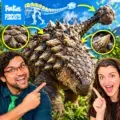 What the thagomizer?! with ReBecca Hunt-FosterSeptember 22, 2026
 Dinosaurs with necks full of airSeptember 8, 2026
 The dinosaurs that ran faster than Usain BoltAugust 31, 2026
 This is Dino QuestAugust 24, 2026