




 Apple Podcasts
 Spotify
 Player FM
 Pocket Casts
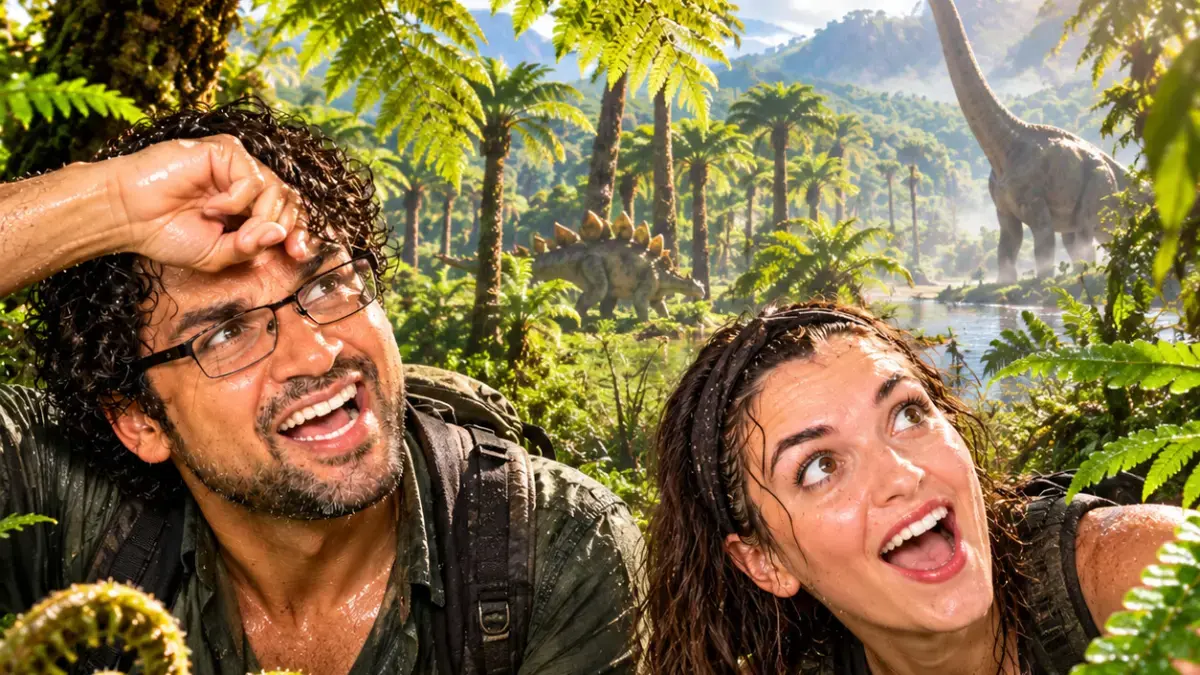
The dinosaurs had around 160 million years on Earth, so there was never just one dinosaur climate. There were deserts, volcanoes and jungles, and there were forests at the North and South Poles, because for most of that time there was no permanent ice anywhere on the planet. Britain was subtropical to tropical. If you were packing for a trip, you would want a raincoat and an autumn jumper, not a snowsuit.
This week’s word is super greenhouse. A greenhouse lets the sun’s heat in through the glass and makes it hard for it to get back out, and carbon dioxide in the air does the same thing to the whole planet. In the super greenhouse of the Cretaceous there was far more of it, sea levels were so high that a seaway split North America down the middle, and temperatures in some places may have reached 40 to 45 degrees. That is hotter than a hot bath.
Fresh from the Dig is all about where dinosaurs lived. The dinosaur highway in Oxfordshire, a 150-metre run of tracks made by long-necked sauropods and the meat-eaters following them, was laid down in a warm, muddy lagoon, exactly the kind of ground that holds on to a footprint. The Carnian Pluvial Episode, roughly two million years of rain in the Triassic, spread forests across the hot, dry supercontinent of Pangaea, and it is one of the leading ideas for why dinosaurs took over. And in northern Alaska, inside the Arctic Circle, palaeontologists have found baby dinosaurs far too young to have migrated, which means dinosaurs lived there all year round, through months of darkness and months of midnight sun.
Lauren and Cassius are joined by Professor Kirsty Edgar, a micropalaeontologist at the University of Birmingham, whose fossils are smaller than a grain of sand. She studies foraminifera, tiny plankton that build shells in the surface ocean and have been doing it for hundreds of millions of years. The oxygen in those shells comes in a lighter and a heavier form, and the mix a shell takes up depends on how warm the water is, so each one is a thermometer that never knew it was a thermometer. When they die the shells sink and pile up on the seabed in layers, oldest at the bottom. Kirsty has spent two-month research voyages drilling that seabed, from Tahiti to Hawaii and from Tasmania round to Perth, one of which set off straight into the tail end of a Southern Ocean storm.
Otis, who is six and from Cardiff, wants to know whether he could have gone swimming in a 45-degree sea. Sadly not: a warm swimming pool is about 30 degrees, a hot bath is about 40, and anything else in the water would have been bigger than him and a better swimmer. Then it is Build a Dino Lab, where one real fact becomes one real piece of the perfect dinosaur. Week five is skin, and Kirsty’s advice is to make it pale, for the same reason a white T-shirt keeps you cooler than a black one. Lauren picks skin that reflects the sun, even though it makes the dinosaur easier to spot, because with a thagomizer and steak-knife teeth it can look after itself, and nobody wants a dinosaur that cooks. Next week, a tail. Probably.
MOBILE: Dino Quest
Lauren and Cassius are building the perfect dinosaur, one real fossil feature at a time!
Recent Episodes
 Dinosaur chicken nuggets with Jingmai O’ConnorOctober 13, 2026
 What the thagomizer?! with ReBecca Hunt-FosterSeptember 22, 2026
 Dinosaurs never needed a dentistSeptember 15, 2026
 Dinosaurs with necks full of airSeptember 8, 2026
 The dinosaurs that ran faster than Usain BoltAugust 31, 2026
 This is Dino QuestAugust 24, 2026