


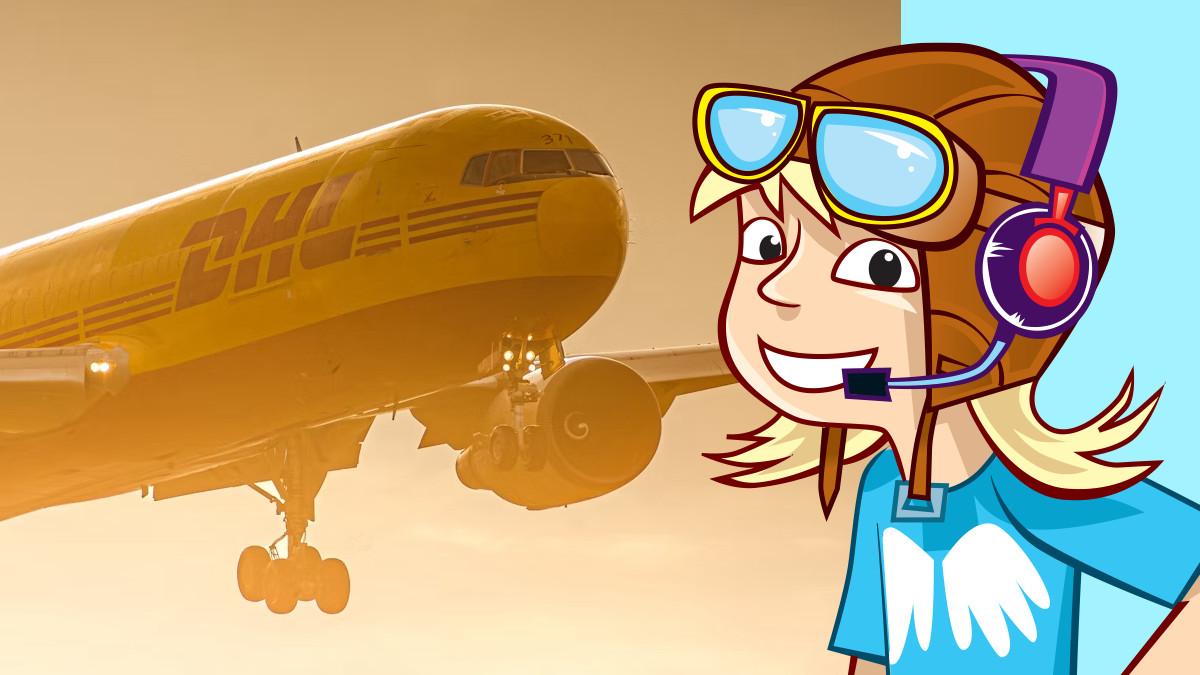
Forget entertainment systems and trolley snacks, we’re heading into the belly: the luggage hold.
Planes and airports aren’t just about passengers. They’re also about transporting everyday goods that we need across the world.
Air freight, also called air cargo, ranges from the post cards that we send home when away to electronic equipment, medicines, clothes, fresh flowers, food… even frozen prawns.

And they’re moved super-fast. Unlike ships and trucks, air freight can deliver in hours, not days. That’s why the UK’s air freight sector supports over 150,000 jobs and is worth over £7 billion!
Just under half of all air freight is carried in the belly of passenger aircraft, with the balance in dedicated freight planes.
And did you know that some passenger planes can be turned into freight planes? As well as removing the seats, they also have to strengthen the floors to handle heavy loads and might add big cargo doors so things can be loaded and unloaded easily.
Then there are specially designed freight planes, which focus on weight capacity than flying fast. Their bodies will generally be wide and tall so they can fit big items in. They might also have high wings so the cargo bay is nice and low to the ground, and have plenty of wheels to support the weight. Some might even have tails mounted way up high so trucks can drive right up and load things straight in.
And some are REALLY big planes… like the Airbus A330, which most people call the Beluga, because… well… it looks like a flying whale! It can carry around 50 tons — that’s about the same as an actual grown-up humpback whale! Or if you prefer… the equivalent weight of 26 small cars or 7 elephants!
It was designed to carry very large airplane parts like wings and fuselage sections between various Airbus factories in Europe. Its design is super clever – the cockpit is below the cargo area, which means cargo can be loaded and unloaded without unplugging all the electrics and hydraulics. It also has a special loading system that allows cargo to be rolled on and off quickly, even when it’s really windy.
Some cargo needs extra special care… like dangerous goods, live animals, fresh food, wet cargo, or things that need to stay at a certain temperature like medicines. Every item has its own travel rules to keep it safe and sound.
When cargo arrives at the airport, it’s checked by customs, scanned by security and sorted by destination. It’s then packed into containers called Unit Load Devices which are like mega suitcases that fit snugly into a plane’s cargo hold using robotic equipment and conveyor belts.
And at the destination, the process is in reverse: unloading, scanning, customs and then dispatch for local delivery. It’s a non-stop ballet of boxes and barcode scanners.
So next time you see a plane overhead, remember, it might not be carrying people… it could be delivering phones, flowers, or even life-saving medicine. Thanks to air freight, the world is more connected than ever. And there’s a wealth of interesting career opportunities – from Airfreight Operations and carrier management to design and border management.
CLICK HERE to find out more about STEM careers in aviation and aerospace with the CAA. Aviation and aerospace needs to be ready for the future and it needs different talent, ideas and values to make that happen. They need talented people like you!
MOBILE: Amy's Aviation: Kids Guide to Airplanes & Airports
The podcast that discovers how airplanes fly and what goes on behind-the-scenes at airports
AMY AVIATION – REACHING FOR THE SKY
CREATED WITH SUPPORT FROM A CAA REACH FOR THE SKY CHALLENGE GRANT – FIND OUT MORE AT CAA.CO.UK
Add a commentAmy’s Aviation
Join Amy Aviation on her quest to find out more about planes and special places!
More From Amy’s Aviation