



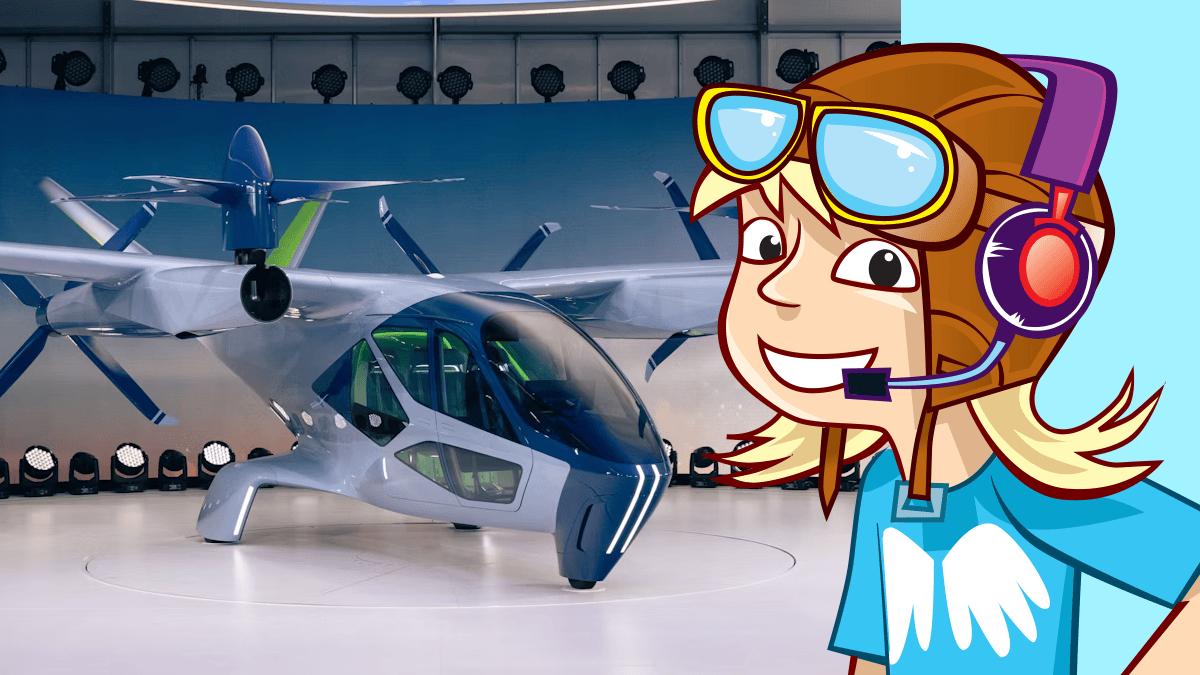
eVTOLs or Vertical Take-Off and Landing vehicles take off vertically… straight up, then fly like a plane before landing again vertically.
They sound fantasy, but by the year 2030, you might be hopping into an air taxi that lifts off from a vertiport and glides over city rooftops.
A eVTOL taxi will probably carry up to 6 people, and travel up to 300 miles on a single electric charge. All-electric, which means they’re quiet, efficient and much better for the environment.
Because they can take off and land vertically, you don’t need runways, just a small landing pad on a roof or maybe near a train station. Imagine this… You hop off a train when it arrives at a city, walk to a vertiport and then zip through the sky to your destination.
To keep things safe and keep noise and emissions to a minimum in populated areas, air taxis will follow special flight corridors, sort of like invisible sky roads that guide them over parks and rivers rather than built up areas.
While they’re not quite ready for take-off yet, several companies are testing designs. Most have multiple rotors for vertical lift and safety – like quadcopters (that’s four rotors), hexacopters (six rotors) and octocopters (eight rotors). Some designs have rotors that can tilt to provide both vertical and horizontal thrust.
Other designs use rotors for vertical lift, and then fixed wings and engines for horizontal movement. And then there’s some with something called ‘Vectored Thrust’ – these have multiple engines that can be pointed in different directions to control lift and thrust, and are more maneuverable than multirotor designs.
eVTOLs won’t just be used for carrying people, they can make deliveries as well – from home deliveries to medical emergencies. They could be a flying ambulance to get someone to surgery! They’re super useful in places where regular planes just can’t go.
There’s still a few big things that need to sorted out, like making sure batteries are sufficiently large to store enough energy to power the VTOL whilst also safe in day to day operations.
They also have to create safe flight routes over built up areas, training pilots how to fly them – and creating emergency procedures to make sure everyone is comfortable and most importantly safe – whether a passenger or someone on the ground below!
And that’s where the many experts come into play… to plan, test and improve systems every step of the way.
CLICK HERE to find out more about STEM careers in aviation and aerospace with the CAA. Aviation and aerospace needs to be ready for the future and it needs different talent, ideas and values to make that happen. They need talented people like you!

MOBILE: Amy's Aviation: Kids Guide to Airplanes & Airports
The podcast that discovers how airplanes fly and what goes on behind-the-scenes at airports
AMY AVIATION – REACHING FOR THE SKY
CREATED WITH SUPPORT FROM A CAA REACH FOR THE SKY CHALLENGE GRANT
Add a commentAmy’s Aviation
Join Amy Aviation on her quest to find out more about planes and special places!
More From Amy’s Aviation