



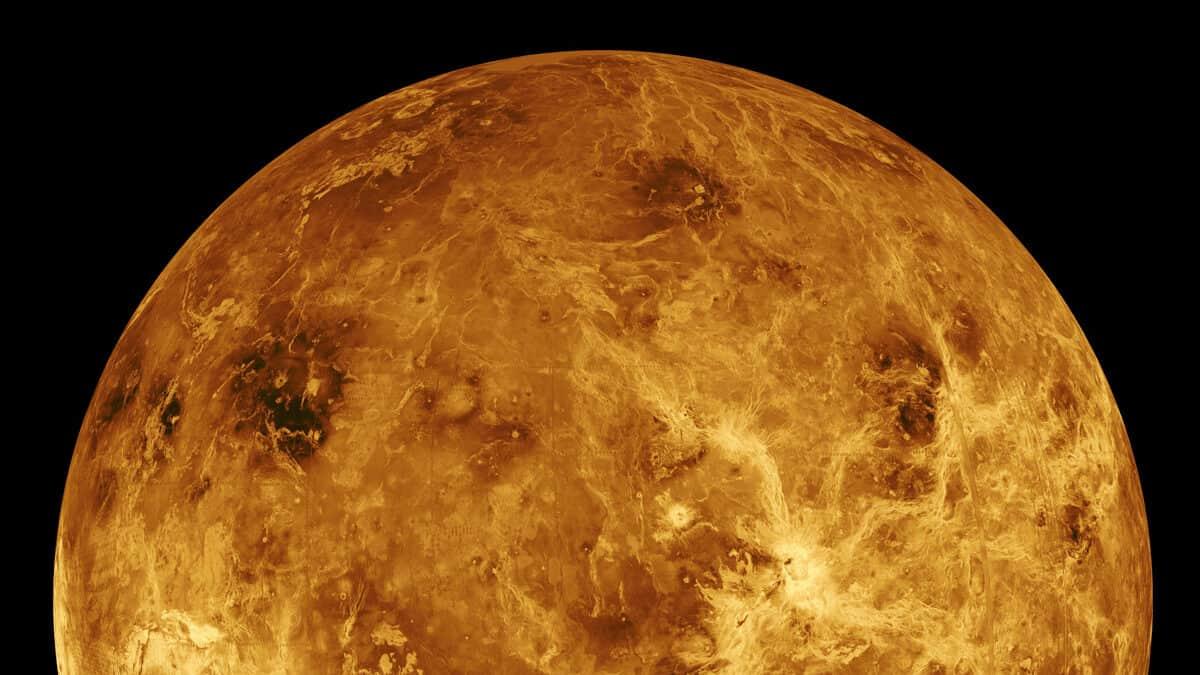
All About Venus
- The second closest planet to the Sun
- Because of the planet’s cloud cover, little can be seen on the planet
- Its almost circular orbital period around the Sun lasts is 224.7 Earth days
- A Venusian day lasts a whopping 118 Earth days
- And the Sun rises in the west and sets in the east since Venus rotates in the opposite direction to Earth!
- It’s the brightest planet in the Solar System, earning it the nickname of ‘the Morning Star’
Venus: The Planet:
- Venusian geography is comprised of a huge plain and some highlands and lowlands.
- The highlands cover approximately 27% of the planet, the lowlands 8%, and the plains the rest. There are two main highland areas known as Ishtar Terra and Aphrodite Terra as well as a third, smaller highland area called Beta Regio where Rhea Mons, Theia Mons, and a shield volcano are found.
- The highest points on Venus, on the eastern side of the Ishtar Terra, are the Maxwell Mountains that were named after the Scottish physicist James Clerk Maxwell.
Venus: The climate:
- The atmosphere consists almost entirely (96%) of carbon dioxide, a greenhouse gas responsible for the incredibly hot, greater than 400ºC conditions on Venus, surpassing the melting point of lead.
- The rest of the atmosphere is comprised of 3% nitrogen, 0.003% water vapour, and small quantities of other gases.
- The atmosphere rises to about 400km above the surface of the planet. The clouds situated around 30 km above the surface are rich in sulfuric acid; during precipitation the acid rain evaporates before hitting the ground.
Venus Factfile:
- The 19th Century astronomer – Franz Von Paula Gruithuisen, believed that inhabitants on the planet were responsible for lighting objects in celebration of the accession of a new emperor
- Until the early 1960s, Venus was believed to possibly be oceanic even though the temperature was enough to make it a vast desert. Finally, in 1962, the Mariner 2 spacecraft passed by Venus and sent back data putting an end to this hopeful theory.
- In 1970, the Soviet Union landed the first spacecraft on the planet’s surface. Venera 7 sent back information for 23 minutes before losing contact with ground control (most likely due to the temperature).
- in 1975, Venera 9 landed and sent back the first image of the rocky Venusian surface (thereby confirming the high temperatures) and returned atmospheric data.
Click here to go to Deep Space High HQ!

Get the free Deep Space High: Kids Guide to Space podcast
Want to learn more about space? Subscribe to our free Deep Space High podcast and get it direct to your computer, iPhone or iPad