


Something spectacular is happening in the sky THIS Wednesday – 12th August.
Here in the UK, we’ll be able to see a big partial solar eclipse!
That’s when the Moon will cover a huge chunk of the Sun – around 95%!
When can I see it? The actions starts around 6pm, with most of the sun covered by 7.12pm
What does a solar eclipse look like? Well, it looks like the Moon is taking a tiny bite out of the Sun!
People have been amazed by eclipses for thousands of years and today scientists know exactly how and why they happen.
So, are you ready to become an eclipse expert? Here’s 10 amazing facts that will help you impress your friends and family the next time you look up at the sky!
1. Eclipses help scientists learn more about the Sun and the Moon.
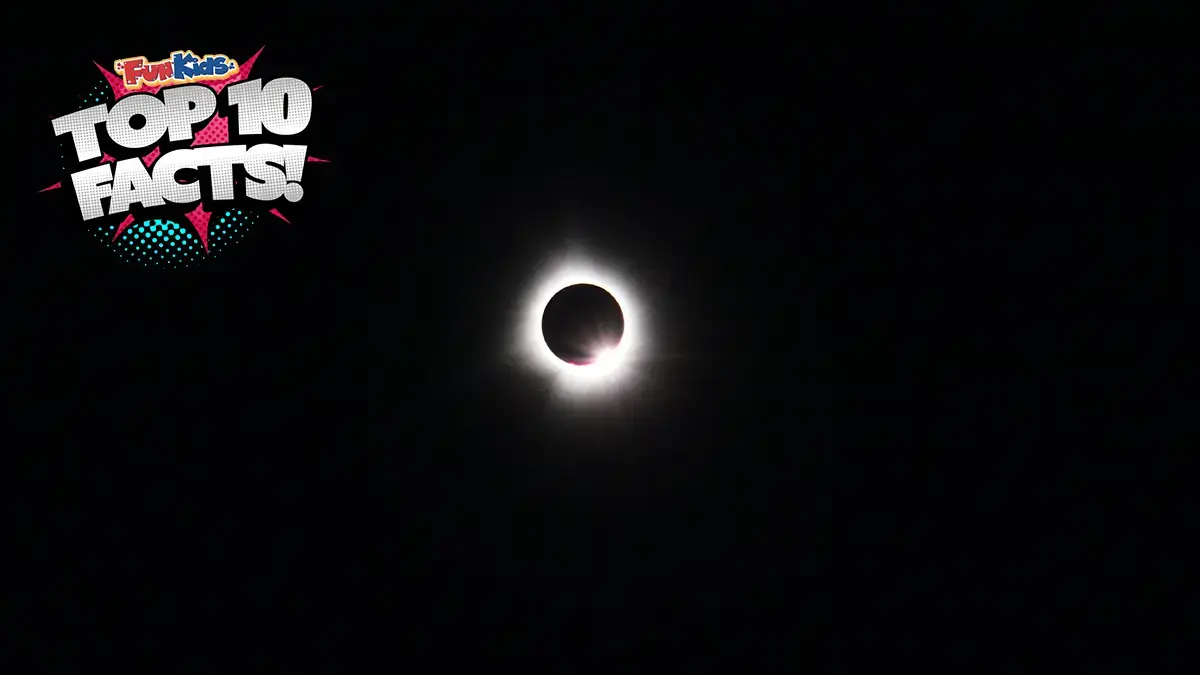
During a total solar eclipse, the bright surface of the Sun is hidden, allowing astronomers to study its outer atmosphere, called the corona, which is usually difficult to see.
Scientists have even used eclipses to test important scientific ideas, including Albert Einstein’s theory of gravity.
Although eclipses are beautiful to watch, they are also valuable opportunities to discover more about our amazing Solar System.
2. An eclipse happens when one object in space blocks the light from another.
During a solar eclipse, the Moon passes between the Earth and the Sun, casting a shadow on part of our planet.
During a lunar eclipse, the Earth moves between the Sun and the Moon, causing the Earth’s shadow to fall across the Moon.
These events only happen when the Sun, Earth and Moon line up in just the right way, which makes every eclipse a special event.
3. Even though the Moon is much smaller than the Sun, they look almost exactly the same size in the sky.
That’s because the Sun is about 400 times wider than the Moon, but it is also about 400 times farther away from Earth.
This amazing coincidence allows the Moon to cover the Sun almost perfectly during a total solar eclipse.
Scientists think this won’t always be true because the Moon is slowly moving farther away from Earth each year.
4. Eclipses don’t happen every month because the Moon’s orbit is tilted slightly compared with the Earth’s path around the Sun.
Most months, the Moon passes a little above or below the Sun instead of directly in front of it.
Only when everything lines up perfectly do we see an eclipse.
This is why solar and lunar eclipses happen only a few times each year, even though the Moon orbits the Earth about once every 27 days.
5. During a total solar eclipse, daytime can suddenly feel like evening.
The sky becomes much darker, the temperature may drop a little, and bright planets or stars can sometimes be seen.
Some animals become confused by the sudden darkness. Birds may stop singing, chickens have been known to return to their coops, and some insects begin making their usual nighttime sounds.
The whole event can be over in just a few minutes before daylight returns.
6. The Moon’s shadow moves across the Earth at incredible speed during a total solar eclipse.
Depending on where it is, the shadow can travel at more than 1,600 kilometres (1,000 miles) per hour.
That means the area experiencing total darkness is constantly moving across the Earth’s surface.
Because the shadow is relatively small, only people standing in a narrow path get to see the Sun completely covered, while others nearby see only a partial eclipse.
7. Looking directly at the Sun during a solar eclipse can seriously damage your eyes, even if the Sun looks partly covered.
Ordinary sunglasses do not protect your eyesight.
The safest way to watch a solar eclipse is by using special eclipse glasses that meet international safety standards or by using a pinhole projector to watch the Sun’s image safely on a piece of paper.
Protecting your eyes is always the most important rule when watching an eclipse.
8. People have been fascinated by eclipses for thousands of years.
Before scientists understood what caused them, many cultures believed they were magical or frightening events.
Some legends said a dragon, giant wolf or monster was swallowing the Sun, while others believed eclipses were messages from the gods.
9. A total solar eclipse never lasts very long.
Even under perfect conditions, the longest possible total eclipse lasts only about seven and a half minutes.
Most total eclipses last for just two or three minutes, while partial eclipses can be seen for much longer before and after totality.
Because they are so brief, many people travel long distances to experience those unforgettable few minutes when the Sun disappears behind the Moon.
10. Scientists can predict eclipses many years, or even centuries, before they happen.
By carefully studying the movements of the Earth and Moon, astronomers can calculate exactly when an eclipse will occur and which places on Earth will have the best view.
These predictions are so accurate that they can even tell the exact time an eclipse will begin and end.
This helps people plan special events and scientific observations long before eclipse day arrives.