



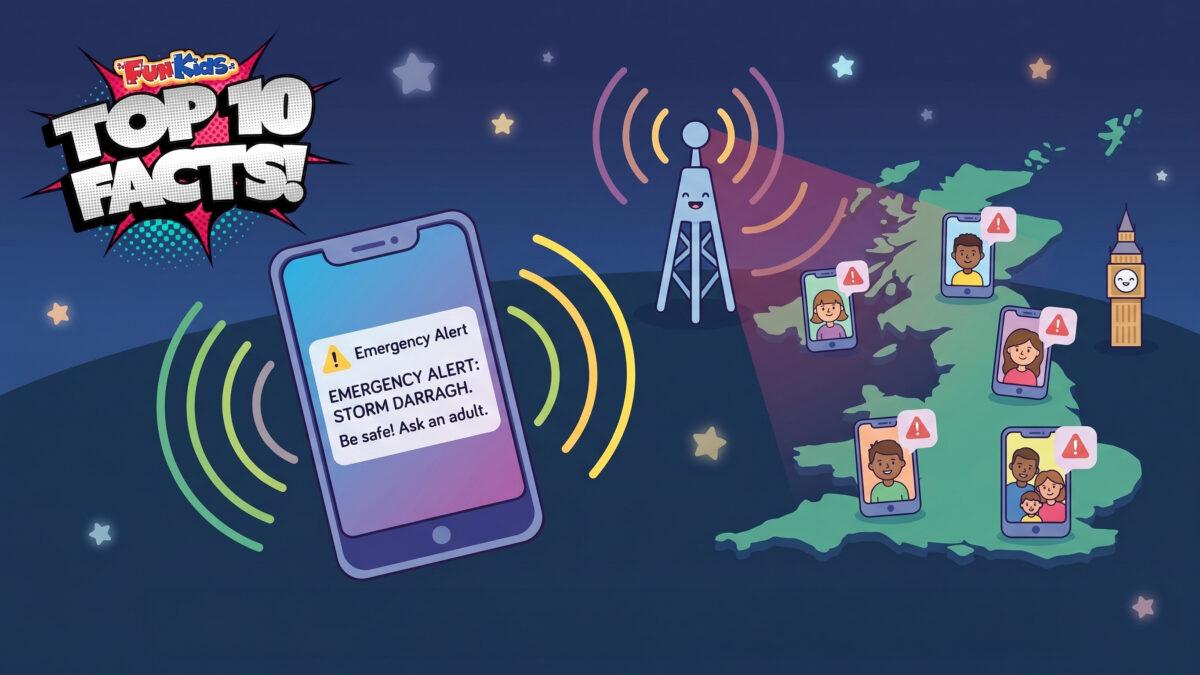
Over the last few years, mobile phones have been used to help the Government and emergency services get important information out there to anyone who needs it.
It can be a bit scary when a loud alarm suddenly sounds, but there’s no need to panic – our Top Ten Facts can help you understand why the messages are sent to help keep us all safe!
1. The UK’s Emergency Alert system is surprisingly new!
The UK’s Emergency Alerts system launched in 2023, so it hasn’t actually been around for very long. The first big test was on 23 April 2023, when millions of phones across the country suddenly made the same loud noise at 3pm. Other countries, including the USA, Canada and Japan, already had similar warning systems.
2. Before Emergency Alerts, warning everybody quickly was much harder.
Imagine there was a dangerous flood and you needed to warn millions of people straight away. Hundreds of years ago, you might have used smoke signals to get the message out, whilst more recently you could have used sirens – the only thing about these are that they don’t provide any information – just a bit of smoke and a sound!
Over the lasy 50 years, you could have used the television and national radio services to get a message out immediately.
And today… well, one could send a text messages to everyone, but sending that one by one isn’t very efficient. During the Covid pandemic, the government used mobile networks to send important messages, but getting messages to everyone could take a long time. Emergency Alerts were therefore created to get urgent warnings to huge numbers of people much faster.
3. An Emergency Alert isn’t actually a text message.
It uses clever technology called cell broadcasting. A mobile phone mast sends out one warning that compatible phones nearby can pick up. Imagine a teacher shouting “Everybody in this playground, listen!” rather than walking up to every single child and telling them separately. That’s roughly what the mobile mast is doing.
4. The government doesn’t need to know who you are.
You don’t have to give the Emergency Alerts system your name, phone number or address. Your phone simply notices that a warning is being broadcast in the area where you are. The system doesn’t collect information about you or track your location.
5. It can warn you even when you’re away from home.
This is one of the really useful things about the system. Imagine you’re on a family camping holiday when a dangerous wildfire starts nearby. Your phone could receive the warning even though you live hundreds of miles away. The alert is based on where your phone is at that time, not where you normally live.
6. The alarm is REALLY loud – and that’s deliberate!
An Emergency Alert can make a loud siren-like sound and vibrate for about 10 seconds, even if your phone is on silent. It might make you jump, but that’s exactly the point! If something dangerous is happening, authorities don’t want you to miss the warning because your phone is tucked inside your school bag or you’ve turned the sound off.
7. Children can help too.
An alert might warn people about something such as a serious flood, wildfire or extreme storm. If you’re with an adult, show them the message and follow their instructions. If you’re old enough to have your own phone and you’re away from your parents – perhaps walking home, visiting friends or travelling – an alert could give you important safety instructions. Don’t panic: read what it says and talk to a trusted adult.
8. Millions of phones can be warned at once.
These aren’t just practice alarms. The system has already been used during real emergencies. During Storm Darragh in December 2024, an alert was sent to around 3.5 million people in Wales and South West England. During Storm Éowyn in January 2025, around 4.5 million people in Scotland and Northern Ireland were sent one. That’s an enormous number of phones receiving an important warning at roughly the same time.
9. You can switch Emergency Alerts off – but there’s a good reason they’re normally left on.
Most people are encouraged to keep alerts switched on because one could warn them about danger. However, there are important exceptions. If you think there are reasons to keep the alerts silent ask a trusted adult for help.
10. If you ever receive a real one, remember: Read it, tell an adult and follow the instructions.
Emergency Alerts aren’t sent every time it rains or gets windy! They’re intended for serious situations where there could be a danger to life. So if your phone suddenly makes that unusual alarm, don’t just swipe the message away.
- Read the alert carefully
- Tell a parent, teacher or another trusted adult if one is nearby
- Follow the safety instructions in the message.
Top 10 Facts
From the Tudors to rocks to fish, we have all the best facts right here!
More From Top 10 Facts