


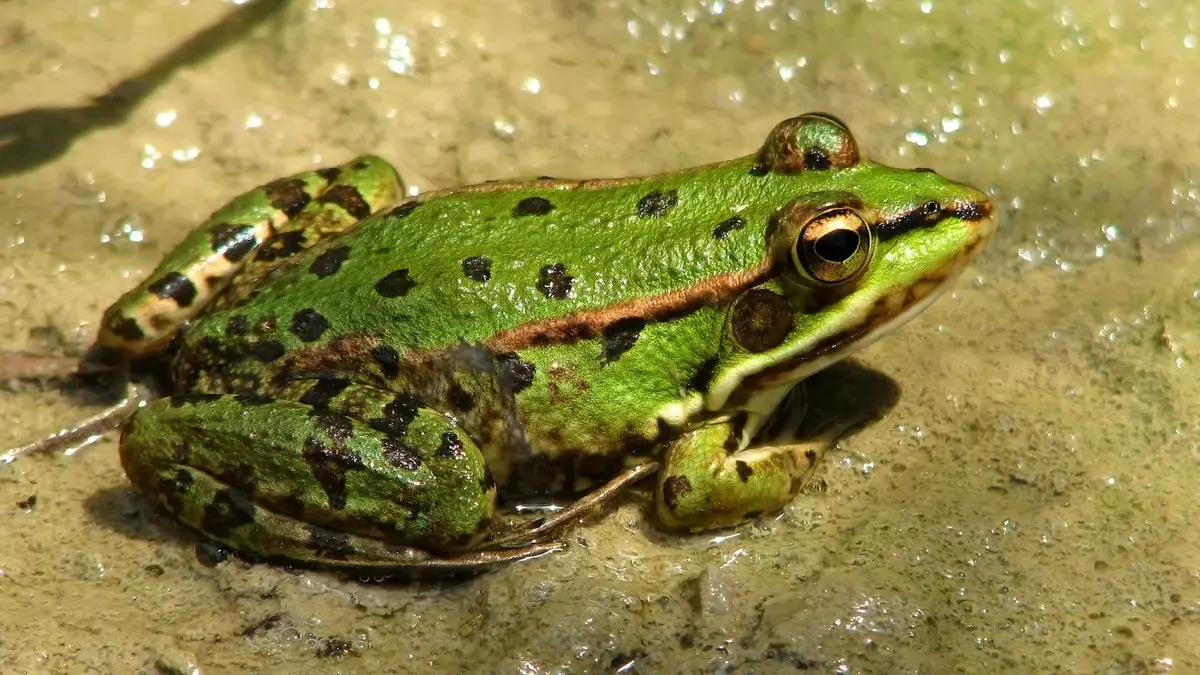
Frogs, toads and newts are amphibians: animals that spend part of their lives in water and part on land. They start out looking nothing like their parents, then change shape completely as they grow. Here are ten facts about amphibians, and the amazing life cycle of a frog.
1. Amphibian means “both lives”.
The name comes from two Greek words meaning “both” and “life”. Most amphibians live their early lives in water and their grown-up lives on land, coming back to the water to lay their eggs.
2. There are three kinds of amphibian.
Frogs and toads are the biggest group. Newts and salamanders have long bodies and tails. The third group, caecilians, have no legs at all and look a bit like giant earthworms. Britain has seven kinds of amphibian of its own: the common frog, the pool frog, the common toad, the natterjack toad, and the smooth, palmate and great crested newts.
3. A frog’s life starts as frogspawn.
In spring, female frogs lay hundreds of eggs in ponds. Each egg is a tiny black dot inside a ball of clear jelly, and they stick together in big clumps called frogspawn. Toads lay their eggs in long strings instead, which is one way to tell them apart.
4. Tadpoles breathe like fish.
After one to three weeks, depending on how warm the water is, tadpoles wriggle out of the jelly. They have a long tail for swimming and breathe underwater through gills, just like a fish. At first they eat algae and bits of plants.
5. Then their bodies change completely.
Back legs grow first, then front legs. Lungs grow so they can breathe air, and the tail gets smaller and smaller. It doesn’t drop off: the tadpole’s body soaks it up and uses it for energy. This big change is called metamorphosis.
6. Froglets leave the pond in summer.
For a common frog, it takes around three months to go from egg to froglet: a tiny frog with a little stump of tail. Froglets hop out of the pond in early summer, and take two or three years to grow into adults that can lay frogspawn of their own. Then the life cycle starts again.
7. Amphibians can breathe through their skin.
Adult frogs have lungs, but they also take in oxygen through their thin, damp skin. That is why amphibians need to stay moist, and why you will usually find them in cool, shady, wet places. Unlike fish and reptiles, amphibians have no scales.
8. Frogs hop, toads walk.
In Britain, the easiest way to tell them apart is to watch them move. Frogs have smooth, damp skin and long back legs for hopping. Toads have drier, bumpy skin and shorter legs, so they tend to crawl. Both are amphibians, and both spend the winter hibernating somewhere sheltered, like under logs, in compost heaps or at the bottom of ponds.
9. Some frogs are poisonous.
Poison dart frogs live in the rainforests of Central and South America. Their bright colours are a warning to predators: don’t eat me! They are poisonous, not venomous, which means they are harmful to touch or eat, but they don’t bite. Find out more in Amazon Threats: Poison Dart Frog.
10. Amphibians need our help.
A big study in 2023 found that around two in every five kinds of amphibian are at risk of dying out, because of disease, pollution, climate change and the loss of ponds and wetlands. You can help by making a small wildlife pond, or leaving a log pile in a shady corner of the garden for frogs and toads to shelter in.
📖 Words to know
- Amphibian
- A vertebrate with smooth, damp skin that usually starts life in water and lives on land as an adult.
- Life cycle
- The way a living thing changes as it grows, from the start of its life until it has young of its own.
- Frogspawn
- A clump of frog eggs, each one inside a ball of jelly.
- Tadpole
- A young frog or toad that lives in water and breathes through gills. Scientists call this stage a larva.
- Metamorphosis
- A big change in an animal’s body shape as it grows, like a tadpole turning into a frog.
⚠️ Watch out!
How much do you know about amphibians?
What is the right order of a frog’s life cycle?
- Frogspawn, tadpole, froglet, frog
- Tadpole, frogspawn, frog, froglet
- Froglet, frogspawn, tadpole, frog
- Frog, froglet, tadpole, frogspawn
How does a young tadpole breathe?
- Through gills
- Through lungs
- Through its tail
- It holds its breath
Which of these is an amphibian?
- A newt
- A lizard
- A snake
- A tortoise
Which group?
Frogs, toads and newts are amphibians, one of the five main groups of vertebrates, along with mammals, birds, fish and reptiles.
Send us your favourite facts!
Is there something we've missed? Got a fact you're dying to tell us? Submit it below and we could use it on a future Top 10 Facts page!
Remember to always ask an adult before filling out forms online.