

Every living thing needs energy to stay alive, and animals get theirs by eating. A food chain shows who is food for whom, from a plant at the start to the animals that depend on it. Here are ten facts about food chains, and how to read one.
1. Almost every food chain starts with a plant.
Plants can’t hunt or graze, so they make their own food, using sunlight, water and a gas from the air called carbon dioxide. This is called photosynthesis. Because they make, or produce, food, plants are called producers. In the sea, the producers are mostly tiny plant-like living things instead (see fact 8).
2. The arrows mean “is food for”.
A simple food chain in a British field looks like this: grass → rabbit → fox. Read each arrow as “is food for”: grass is food for the rabbit, and the rabbit is food for the fox. The arrows point the way the energy travels, from the food to the animal that eats it.
3. Animals are consumers.
Animals can’t make their own food, so they have to eat, or consume, plants or other animals. Herbivores eat only plants, carnivores eat mostly meat, and omnivores, like humans, eat both. The first animal in a food chain eats the plant, so it is always a herbivore or an omnivore.
4. Lots of animals are both predator and prey.
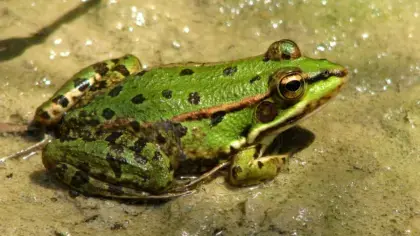
Look at this garden food chain: leaf → caterpillar → blue tit → sparrowhawk. The blue tit is a predator when it catches caterpillars, and prey when a sparrowhawk catches it. Frogs are the same: they hunt insects and slugs, but herons and grass snakes hunt them.
5. Not every meat-eater is a hunter.
Vultures are carnivores, but they rarely kill anything. They are scavengers, which means they eat animals that have already died, or leftovers from another animal’s meal. Crows, gulls and even some foxes scavenge too.
6. Predators aren’t always bigger than their prey.
A weasel is small enough to fit through a hole the size of a ring, but it can catch a rabbit much bigger than itself. Lionesses work together to bring down buffalo and even giraffes, and some spiders can catch insects larger than they are.
7. Food chains join up to make food webs.
A food chain only ever shows one meal at a time, but most animals eat lots of different things. A fox eats rabbits, mice, worms, beetles and berries, so it belongs to many food chains at once. Join all the chains in one place together and you get a food web.
8. In the sea, food chains start tiny.
Ocean food chains begin with plant-like living things called phytoplankton, many of them far too small to see. They are food for krill, small shrimp-like animals, and krill are food for the biggest animal that has ever lived: the blue whale. Lots of fish, penguins and seals depend on krill too.
9. Some animals sit at the top of the chain.
An animal that has no predators of its own when it is grown up is called an apex predator. Polar bears on the Arctic ice and orcas in the oceans are apex predators. Being at the top doesn’t make them more important: without the animals below them, they would starve.
10. Change one link, and the whole chain feels it.
Off the coast of North America, sea otters eat sea urchins, and sea urchins eat kelp, a giant seaweed. When hunters killed most of the otters, the urchins ate so much kelp that whole underwater forests disappeared, along with the fish that lived in them. Where otters have come back, the kelp has started to grow again.
📖 Words to know
- Food chain
- A diagram showing how living things depend on each other for food.
- Producer
- A living thing that makes its own food, like a plant. Every food chain starts with one.
- Consumer
- An animal that eats plants or other animals.
- Predator
- An animal that hunts, kills and eats other animals. The animals it hunts are its prey.
- Scavenger
- An animal that eats animals that are already dead.
⚠️ Watch out!
How much do you know about food chains?
What does the arrow in a food chain mean?
- Is food for
- Eats
- Is bigger than
- Is scared of
What do most food chains start with?
- A plant
- The smallest animal
- The biggest animal
- The sea
What do we call an animal that eats animals that are already dead?
- A scavenger
- A producer
- A herbivore
- A hibernator
Find out which group each animal belongs to in Top 10 Facts About Animal Groups.
Send us your favourite facts!
Is there something we've missed? Got a fact you're dying to tell us? Submit it below and we could use it on a future Top 10 Facts page!
Remember to always ask an adult before filling out forms online.